
How to Renovate an Investment Property for Better Rental ROI
Renovating your own home and renovating an investment property are two very different things.
When renovating a home for yourself, it makes sense to choose finishes, colours, furniture and features based on your personal preferences. You are the person who will be living there.
But when renovating a rental investment property, the goal is different.
Your renovation needs to attract the right tenants, remain practical to maintain and support the rental income you want to achieve.
A beautifully renovated property may attract attention, but spending more does not automatically mean earning more rent.
For property owners, the better question is not:
“How can I make this property look as luxurious as possible?”
It is:
“Which renovations will actually help my property perform better in the rental market?”
Don't Renovate Your Investment Property Like Your Own Home
One of the most common mistakes property owners make is allowing personal preferences to influence too many renovation decisions.
You may personally prefer a particular colour, expensive material, designer furniture or highly customised interior.
But your tenant may not value those things enough to pay additional rent for them.
For example, spending significantly more on premium finishes might make the property look better, but if comparable units in the same development are renting within a similar price range, the additional renovation cost may only result in a small increase in achievable rent.
That creates a simple problem:
You spent more, but your rental income did not increase proportionately.
An investment property should therefore be treated as an income-generating asset, not as a personal dream home.

Start With Your Target Tenant
Before deciding on colours, furniture or finishes, ask a more important question:
Who is actually going to rent this property?
Different properties attract different tenant profiles, and those tenants may value completely different things.
A studio apartment near a business district may primarily attract young professionals. A property close to a university may attract students. A larger three-bedroom unit may appeal more to families or professional sharers.
Your renovation should reflect that target market.
Instead of designing something that appeals specifically to you, create a property that appeals to the largest suitable tenant pool for your unit.
Renovate Based on What Tenants Actually Need
Once you understand your target tenant, you can determine where your renovation budget should go.
For example, student accommodation may benefit more from practical storage, study areas, durable furniture and efficient use of space than expensive decorative features.
Working professionals may place greater value on a clean, modern environment, comfortable furniture, practical storage and a home that feels calm after work.
Families may prioritise durability, storage, functional living areas and practical bedroom layouts.
The objective is not to predict every individual tenant's preferences.
It is to understand what your likely tenant group generally values and design accordingly.

Don't Assume Expensive Means Better Rental Returns
Another common mistake is assuming that a more expensive renovation automatically creates a more profitable rental property.
It doesn't.
Imagine two renovation options.
Option A costs RM40,000.Option B costs RM60,000.
If both properties can realistically achieve approximately the same rental rate, that additional RM20,000 becomes difficult to justify purely as an investment.
Even if the more expensive renovation increases rent by RM200 per month, that additional RM20,000 would take roughly 100 months or more than eight years to recover through the extra RM200 alone, before considering other costs.
This is why renovation decisions should be evaluated financially, not emotionally.
Ask:
“If I spend more here, will tenants actually pay more for it?”
If the answer is no, that money may be better spent elsewhere.

Prioritise Function Before Decoration
For a rental property, functionality should usually come before purely decorative upgrades.
Tenants interact with practical features every day.
Storage, lighting, air-conditioning, comfortable furniture, sufficient power points, usable workspaces and an efficient layout can influence how comfortable a property feels.
An expensive feature wall may photograph beautifully.
But if the bedroom doesn't have enough storage, the tenant is more likely to notice the missing storage than the premium wall finish.
This doesn't mean your rental property should look basic.
Good rental design should combine appearance with functionality.
The difference is that every major design decision should have a purpose.
Choose Materials With Rental Use in Mind
Investment properties also experience wear and tear.
That means owners should think beyond how something looks when it is brand new.
Consider how easily it can be cleaned, repaired or replaced after several years and multiple tenancies.
A beautiful but extremely delicate material may make sense in your own home if you are willing to maintain it carefully.
In a rental property, a slightly more durable and easily replaceable alternative may be the smarter investment.
The same principle applies to furniture.
Highly customised furniture can look impressive, but standardised or easily replaceable items may reduce future maintenance and replacement costs.
Design for the entire investment lifecycle—not just the first listing photos.

Don't Over-Renovate Beyond Your Market
Your property's location and surrounding rental market also place a practical limit on how much tenants may be willing to pay.
If similar units in your development generally rent within a certain range, spending significantly more on renovation does not automatically allow you to charge significantly more.
Your unit may become one of the most attractive options in the development, which can certainly help with tenant appeal.
But there is still a point where additional renovation spending produces diminishing returns.
This is why owners should understand their expected rental range before setting a renovation budget.
Work backwards:
Expected Rental → Target Tenant → Necessary Features → Renovation Budget
Not:
Renovation Budget → Build Everything → Hope for Higher Rent

A Good Investment Renovation Is About ROI
Ultimately, an investment property's renovation should help the property perform as an investment.
That means balancing several objectives:
Attractive enough to compete for tenants
Functional enough for everyday living
Durable enough for repeated rental use
Cost-effective enough to protect your initial investment
Appropriate for the property's target rental market
The most expensive renovation is not necessarily the best renovation.
The best renovation is one where every ringgit has a reason for being spent.
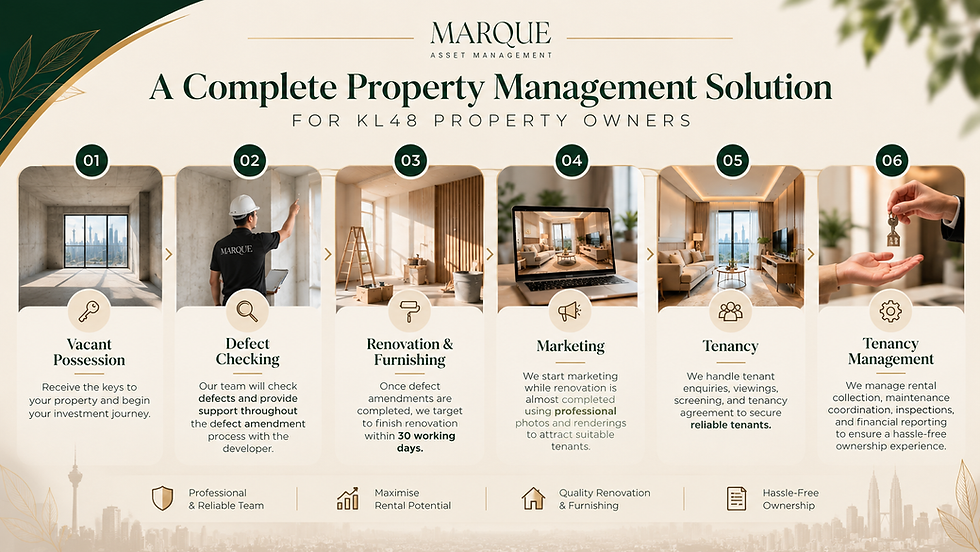
How Marque Designs Investment Properties With ROI in Mind
At Marque Asset Management, we approach renovation differently from designing a personal home.
Before recommending how an investment property should look, we consider the property itself, its location, expected rental range, competing units and the type of tenant it is likely to attract.
From there, we determine where the renovation budget can create the most value—and where owners may be spending unnecessarily.
Our objective is not simply to make a property look expensive.
It is to create a rental-ready property that is attractive, functional, durable and commercially sensible.
Because when you're renovating an investment property, the goal isn't to create the home you would personally want to live in.
It's to create the property your target tenant wants to rent.


Comments